2026-07-30
 36
36
1.1 Study Design and Patient Baseline
On July 15, 2026, the research team led by Professor Liang Tingbo from The First Affiliated Hospital, Zhejiang University School of Medicine published a research paper entitled GPC3‑specific dnTGFβRII‑armoured CAR T cells for hepatocellular carcinoma in Nature, one of the world’s top‑tier international journals. This represents the first‑in‑human trial report for C‑CAR031, the world’s first GPC3‑targeted CAR‑T product armed with dnTGFβRII, for advanced hepatocellular carcinoma (HCC).
This open‑label, single‑arm Phase I clinical trial (NCT05155189) enrolled a total of 36 patients with advanced hepatocellular carcinoma who had received multiple prior lines of therapy. The patient baseline posed substantial clinical challenges: 94.4% of subjects were at BCLC Stage C, 83.3% had extrahepatic metastasis, and the median number of prior treatment lines reached four. Patients received a single infusion of C‑CAR031 at four dose levels ranging from 0.75×10⁶ to 4.0×10⁶ cells per kilogram of body weight, with a 100% product manufacturing success rate.
1.2 Armour Design Concept: Disarming the TGFβ Immune Barrier
Glypican‑3 (GPC3) is highly expressed in hepatocellular carcinoma yet barely detectable in normal tissues, making it an ideal target for CAR‑T therapy. Nevertheless, previous GPC3‑targeted CAR‑T candidates yielded limited clinical efficacy. A key obstacle lies in high levels of transforming growth factor‑β (TGFβ) within the tumour microenvironment. As a potent immunosuppressive factor, TGFβ forms a formidable barrier that strongly impairs T‑cell function.
To overcome this bottleneck, the research team developed an “armour” strategy: GPC3‑targeted CAR‑T cells were engineered to co‑express dominant‑negative TGFβ receptor II (dnTGFβRII). This truncated receptor competitively sequesters TGFβ and blocks downstream signalling, functionally equipping CAR‑T cells with protective “body armour” against immunosuppression.
1.3 Clinical Data: First‑line‑Magnitude Survival Benefit for Heavily Pretreated Patients
The median overall survival (mOS) of 14.2 months significantly outperforms the 8.5‑10.6 months observed with current standard second‑line regimens for HCC. It is comparable to, or even superior to, benchmark first‑line agents lenvatinib (13.6 months) and sorafenib (12.3 months). These findings suggest that C‑CAR031 can deliver first‑line‑level survival benefits for advanced liver‑cancer patients with few remaining treatment options.
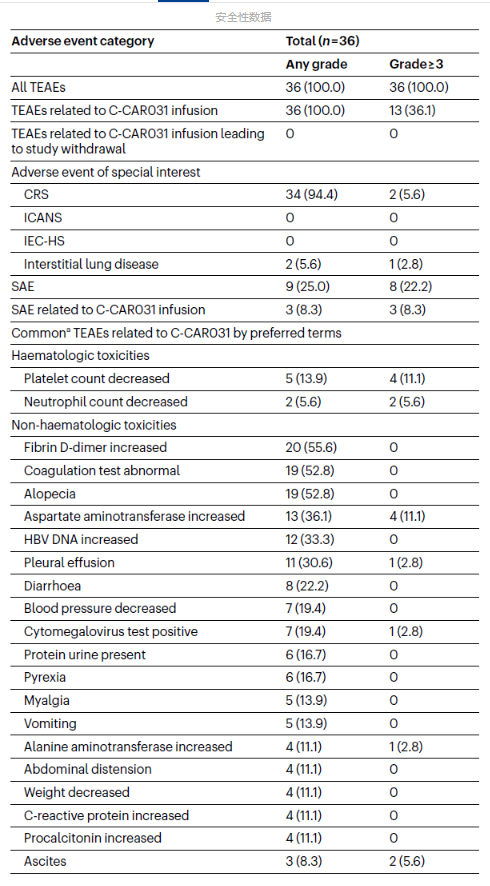
C‑CAR031 demonstrated a manageable safety profile overall. Cytokine‑release syndrome (CRS) occurred in 94.4% of patients, predominantly Grade 1‑2, with only two Grade 3 CRS events reported in the highest‑dose cohort. No immune effector‑cell‑associated neurotoxicity syndrome (ICANS) or IEC‑HS was observed. Three patients (8.3%) experienced infusion‑related serious adverse events.
1.4 Exploration of Resistance Mechanisms: Guiding Next‑Generation Product Design
Beyond clinical outcomes, high‑throughput spatial omics analysis uncovered molecular mechanisms underlying therapeutic resistance:
These insights provide robust biological rationale for next‑generation product engineering and combination strategies, including pairing with immune‑checkpoint inhibitors and anti‑angiogenic agents.
With an objective response rate (ORR) of 44.4% and median overall survival of 14.2 months in liver cancer, C‑CAR031 marks a pivotal shift for CAR‑T against solid tumours — moving from proof‑of‑concept toward clinical validation.
Innovation in solid‑tumour cell therapy is advancing on multiple fronts:
Cell therapy is advancing at unprecedented speed, expanding from haematological malignancies toward solid tumours, bringing tangible hope to patients and unlocking broader opportunities for the biotech industry.





Copyright © 2026 Orchid Therapeutics Co., Ltd. all rights reserved